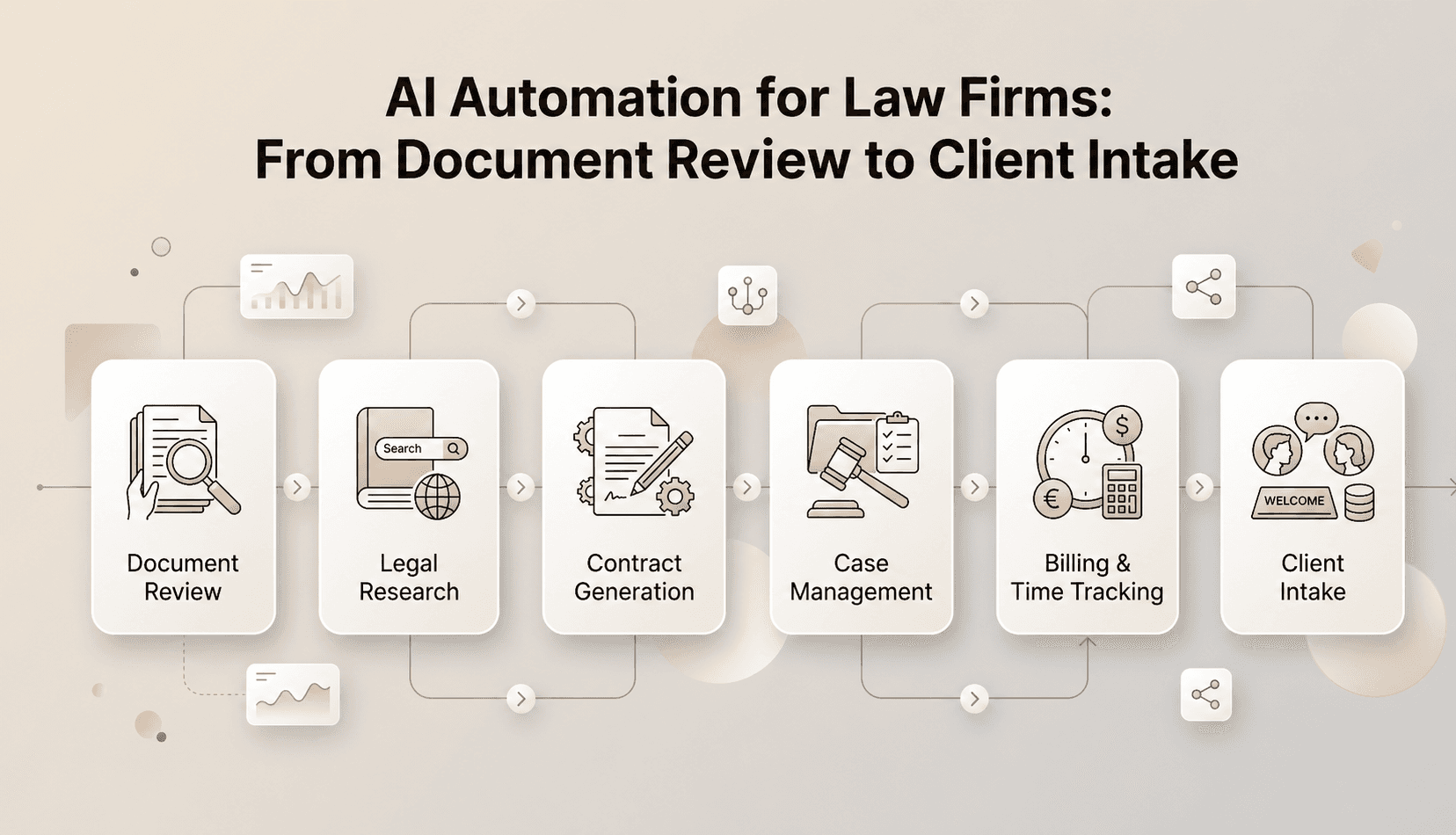
Legal AI automation that amplifies judgement, not replaces it.
Law firms operate on one of the most time-intensive business models in any industry. Associates spend 60% or more of their capacity on tasks that require attention but not necessarily legal judgement: document review, contract comparison, due diligence data extraction, intake form processing, and compliance checks.
AI automation handles the volume work so lawyers can focus on the high-value analysis, strategy, and client counsel that justify premium billing rates. The firms adopting it are not cutting lawyers. They are making each lawyer dramatically more productive.
reduction in document review time reported by firms using AI-powered contract analysis tools, with accuracy rates matching or exceeding manual review.
6 High-Value Workflows to Automate
These workflows represent the greatest time savings with the lowest risk to client outcomes. Each keeps human judgement where it matters while automating the preparation and processing layers.
Compliance and Ethical Considerations
Legal AI automation operates under stricter ethical constraints than most industries. Professional conduct rules, client confidentiality, and the duty of competence all apply to how firms deploy AI.
ROI Data from Early Adopters
Key insight: Firms that implement AI automation report higher associate satisfaction scores. When you remove the grunt work, lawyers spend more time on the intellectually challenging work that attracted them to the profession.
Implementation Approach
Legal AI automation requires a deliberate, phased approach. Start with low-risk workflows, validate accuracy, then expand.
Key Takeaways
Legal and healthcare are the two highest-stakes compliance environments for AI in the UK. See how we approach AI automation in UK healthcare and AI automation in fintech for the same compliance-first methodology. Our AI Automation service covers end-to-end design, build, and deployment for legal teams.
Ready to automate your legal operations?
We will map your highest-value automation opportunities and build systems that respect client confidentiality and SRA professional conduct rules.