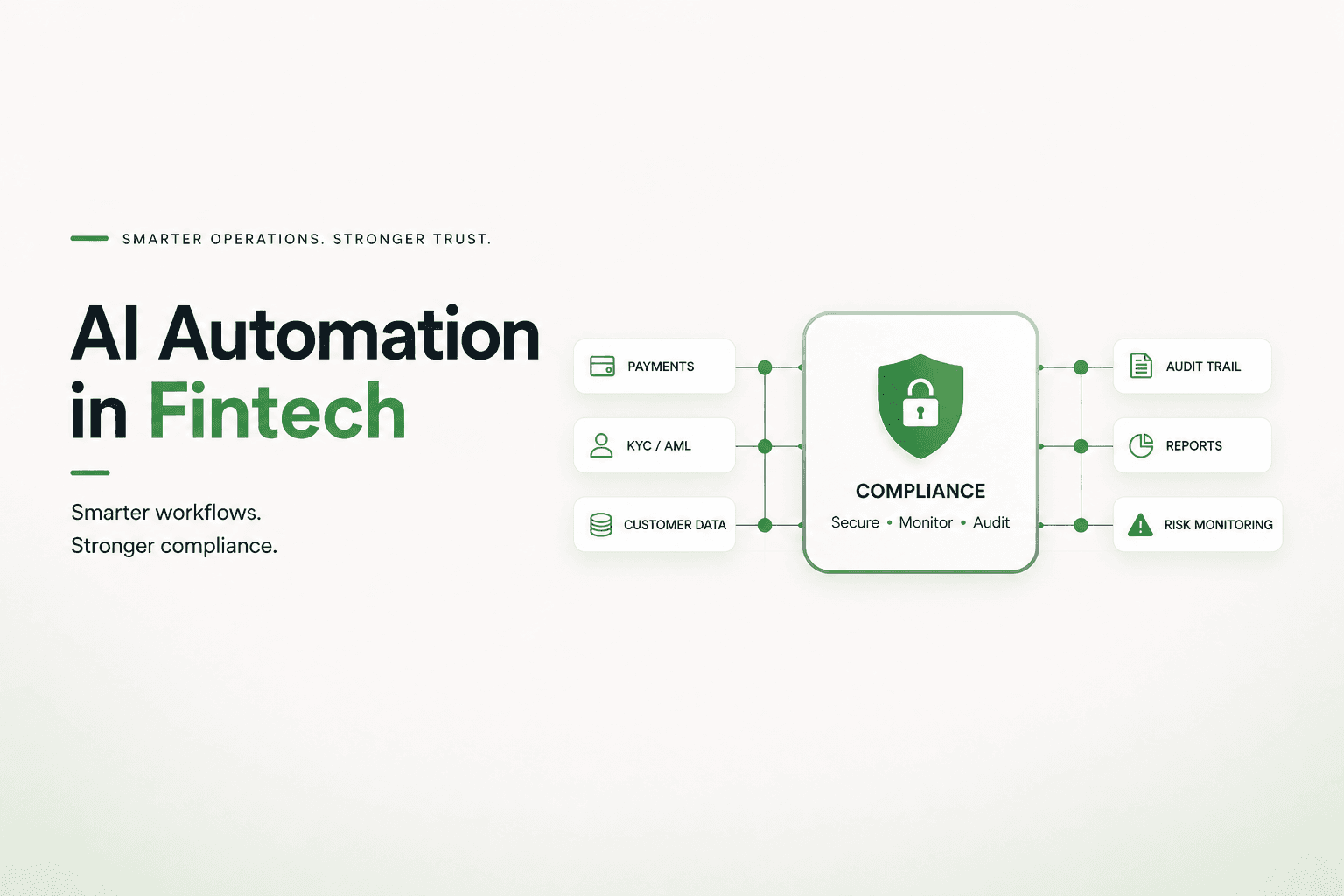
Fintech automation works best when you implement it correctly.
Fintech companies handle repetitive, high-stakes processes reconciliation, reporting, KYC checks, fraud alerts that are perfect for AI automation. The catch: compliance requirements mean you need to implement it correctly.
The opportunity is substantial. Finance teams spend over 60% of their time on manual data tasks entering, checking, reconciling, and reformatting information that a well-built automation pipeline could handle in seconds.
of finance team time is spent on manual data tasks that are prime candidates for AI automation.
The fintech companies doing this well aren't automating everything at once. They identify the highest-value workflows, build with compliance baked in from the start, and expand from there.
5 Highest-Value Workflows to Automate
Not all fintech workflows carry the same automation potential. These five consistently deliver the strongest return on implementation time and cost.
Compliance & AI
Fintech automation doesn't exist in a compliance vacuum. The regulatory environment in the UK FCA oversight, GDPR, and increasingly detailed expectations around model use means that building fast and building compliantly are not optional trade-offs. You have to do both.
Model explainability is increasingly a regulatory expectation, not just good practice. If a regulator asks how your fraud model reached a decision, you need to be able to answer. Build this requirement into your architecture before you go live, not after.
Case Study: CloudFO
CloudFO AI-Powered Finance Assistant
CloudFO needed to move beyond manual financial check-ins and fragmented reporting across Xero, Stripe, and multiple banking APIs. Axonari built an AI-powered finance assistant that pulled data from all three sources, automated weekly financial check-ins, and delivered smart planning with real-time goal tracking.
"What used to take our team days now runs overnight."
90-Day Implementation Roadmap
The fintech companies that succeed with automation don't try to automate everything at once. They move in short phases, validate before expanding, and keep compliance in every sprint.
5 highest-value fintech workflows to automate
1. KYC and customer onboarding
Manual KYC checks take days and cost £30–£80 per application in staff time. AI-powered onboarding automates document verification, runs sanctions and PEP screening against real-time databases, and flags anomalies for human review. Compliant onboarding that took 3–5 days can be reduced to under 4 hours. The human review step remains — AI handles the data extraction and initial screening.
2. Financial reconciliation
Finance teams reconciling transactions manually across multiple systems (banking APIs, payment processors, accounting software) spend 15–25 hours per month on tasks that are perfectly suited to automation. AI reconciliation tools pull data across sources, match transactions automatically, and flag unmatched items for human resolution. Reconciliation accuracy improves and month-end close cycles shorten significantly.
3. Fraud detection and alerting
Rule-based fraud systems generate excessive false positives and miss novel attack patterns. ML-based fraud detection models score transactions in milliseconds, surface genuine anomalies, and auto-block or flag for review based on configurable risk thresholds. FCA-regulated firms must document how their fraud models work and how decisions are reviewed — build explainability and audit logging in from day one.
4. Regulatory reporting (FCA, AML, CASS)
Regulatory reports — CASS reconciliations, Suspicious Activity Reports, AML transaction monitoring summaries — require data from across multiple systems compiled on fixed schedules. Automated reporting pipelines extract the right data, apply the correct aggregation logic, and generate the report in the required format. Staff time shifts from assembly to review. Submission deadlines are met automatically.
5. Cash flow forecasting and financial intelligence
AI models trained on transaction history, payment terms, and seasonal patterns can produce rolling 13-week cash flow forecasts with higher accuracy than spreadsheet-based approaches. The CloudFO system Axonari built pulls live data from Xero, Stripe, and banking APIs, runs automated weekly check-ins, and delivers real-time goal tracking — replacing what previously took the finance team three days of manual work per month.
FCA compliance and model explainability
Fintech automation in the UK operates under FCA oversight, UK GDPR, and for relevant firms, CASS rules. The FCA's expectations around AI model use are increasingly specific: firms must be able to explain how automated decisions are reached, maintain audit trails, and demonstrate human oversight of outputs that affect customer outcomes. Model explainability is not a nice-to-have — it's a regulatory expectation. Firms that cannot explain a fraud decision or a credit risk score to the FCA are creating enforcement exposure.
For AI automation under strict regulatory frameworks, see also how we approach AI automation in UK healthcare and AI automation for law firms. Our AI Automation service covers compliance architecture for regulated industries.
Common mistakes
Most fintech automation failures aren't technology failures. They're implementation failures that were predictable.
Key takeaways
Ready to automate your fintech operations?
We'll map your highest-value automation opportunities and build a compliant, auditable system your compliance team can sign off on.